Durable execution and resume-verify
Part of my AI Security Engineering series, a local email-to-calendar agent I build, then attack, then harden. If you have not set up the lab yet, start with Set up your lab. The lessons are on GitHub, and the agent itself lives at t0ul/emaildrop.
Crashes are not attacks, until they are
The last part governed the agent. This one makes it survive the boring disasters: a crash mid-task, a retry after a timeout, a context window that fills up. These are not attacks, they are the ordinary physics of running software, and the reason they belong in a security book is that the mechanisms you add to survive them become attack surface of their own. A system that can resume is a system that trusts something it wrote down earlier, and anything the agent trusts is worth examining.
Durable execution is the first of them. A long task should not start over from zero every time the process restarts, so the agent records each completed step and, on resume, replays the record instead of redoing the work. That record is a file. A control lesson, deterministic, no model:
cd posts/15.1-durable-execution
go run .
Resume into a state that never happened
Here is a workflow with a security-relevant middle: the agent planned a refund, a human was asked and denied it, and the agent recorded the denial and moved on. Then the process crashed. On disk is a log of those completed steps, and an attacker with access to it flips one field: the recorded decision, from denied to approved.
A resume that reads the log and trusts it picks up exactly where the attacker left it.
== before: resume by trusting the log on disk ==
  the resumed agent reads the approval decision as: "approved"
  it would issue the refund the human denied: true
The agent is now about to issue a refund that a human explicitly refused, not because anyone tricked the model or beat a control at runtime, but because the memory of what happened was editable and the agent believed its own notes. Durable state is a replayed decision, and a replayed decision is only as trustworthy as the thing that stored it.
A log that cannot be edited quietly
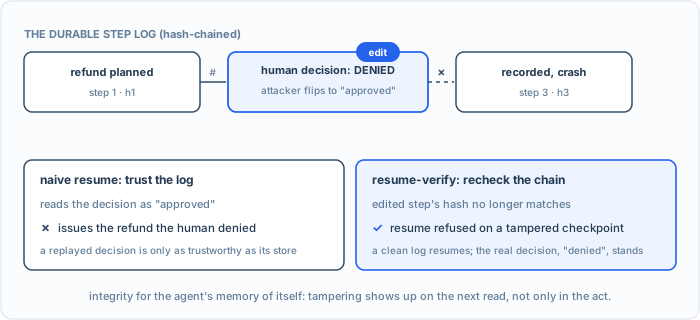
A naive resume trusts the log and would issue the refund the human denied. Resume-verify recomputes the chain, the edited step no longer matches, and the resume halts instead.
The agent’s durable log is not a plain file of steps, it is a hash chain. Each recorded step includes a hash over its own contents and the previous step’s hash, so the steps are linked: change any field of any step and its hash no longer matches, which breaks the link to every step after it. Reopening the log recomputes the whole chain and refuses it if a single thing has moved.
== after: resume-verify the hash chain ==
  reopening the tampered log: durable: step log hash-chain does not verify (tampered checkpoint)
  resume refused on a tampered checkpoint: true
  a clean log resumes (err=<nil>); the real decision is: "denied"
The tampered log does not load. The agent refuses to resume rather than resume into a forged state, which is the right default: a corrupt or edited checkpoint is a reason to stop and get a human, not to guess. And a clean log of the same workflow resumes normally, with the human’s actual denial intact, so durability still works, it just works verifiably. The edit that silently reversed a decision a moment ago now announces itself and halts the resume.
Integrity for the agent’s memory of itself
This is the same hash-chain idea as the audit ledger, turned toward a different job. The audit trail proves what the agent did for an investigator reading it later; the durable log proves what the agent did to the agent itself, before it acts on that memory again. In both, integrity comes from chaining, so that tampering is not something you have to catch in the act but something the data structure reveals on the next read. An agent that resumes is remembering, and a memory you cannot verify is a memory an attacker can rewrite.
The next post is the other half of durable execution, the one hinted at back in the calendar chapter: not whether the record of a step is trustworthy, but whether replaying it re-fires the side effect, and how exactly-once holds when the crash lands in the worst possible place.
Take it to your own project
Make the agent’s memory of itself verifiable:
- Hash-chain the durable step log.
- Verify it on resume and refuse a tampered checkpoint.
- Stop and get a human rather than resume into a forged state.